Anthropic — the AI company behind Claude — just published one of the most honest assessments of AI's impact on jobs I've ever seen from an industry insider. And it confirms what I've been telling parents for a decade:
The world your children are being prepared for will not exist when they graduate.
Let me show you what they found, what it means, and what you need to do about it.
The Data: Who's Getting Hit
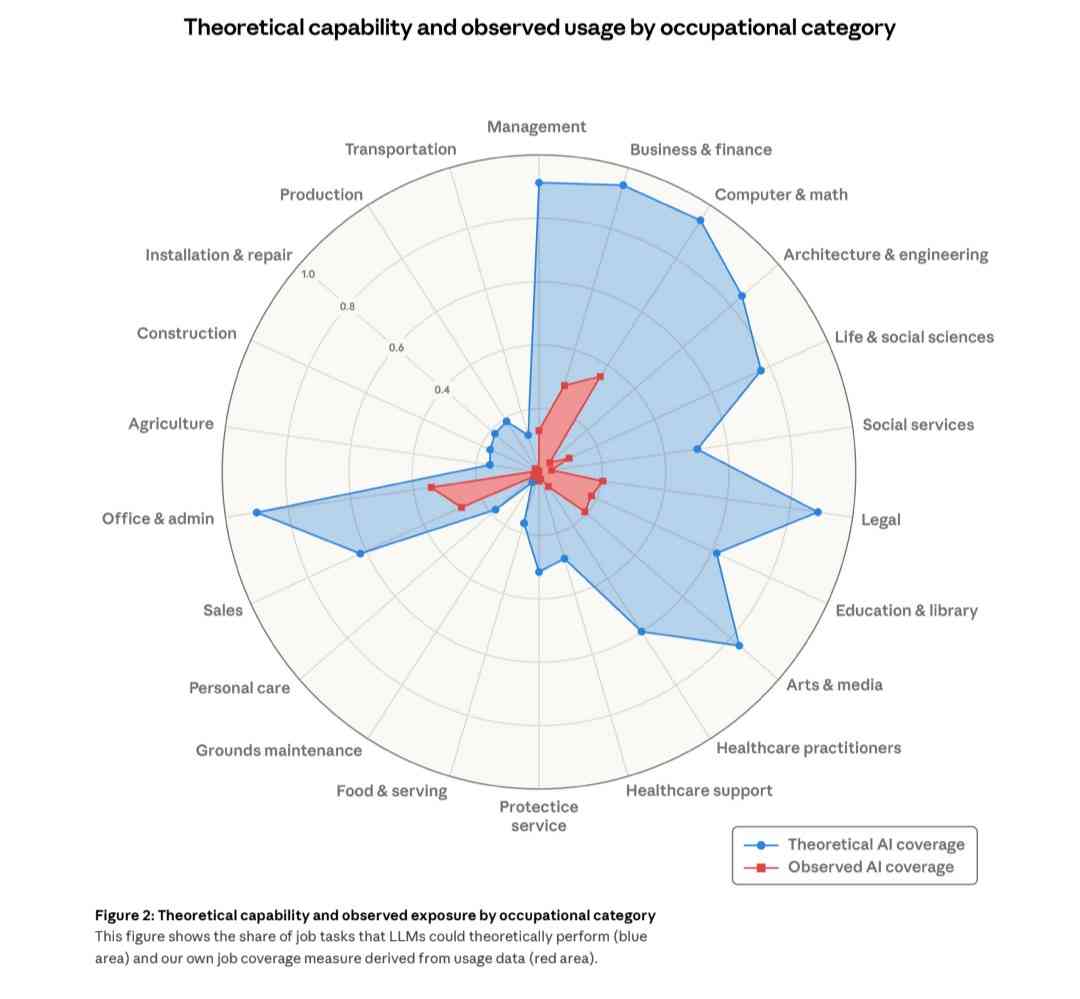
Source: Anthropic Research — Theoretical AI capability (blue) vs. current observed usage (red)
Look at that chart carefully. The blue area shows what AI can theoretically do today. The red shows what's actually happening. The gap between them isn't a buffer of safety — it's a countdown.
Here's what the report reveals:
- Most at-risk jobs: Computer programmers, financial analysts, customer service — the "good jobs" we told kids to pursue
- Most at-risk workers: Female, white, older, and higher-paid. The people who thought they were secure.
- College graduates are 4X more likely to be affected than non-graduates
- Entry-level hiring has dropped 14% since ChatGPT launched — for high-risk jobs
- Safest jobs: Bartenders, dishwashers, lifeguards — manual labor AI can't automate yet
Here's the part that should alarm you: Companies aren't firing people in high-risk jobs. They've stopped hiring. The bloodbath isn't visible yet because it's happening through attrition. The jobs disappearing are the ones that were never posted.
What the Chart Doesn't Show: Acceleration
That chart shows a snapshot — a single frame. What it doesn't capture is the speed at which that blue area is expanding.
When I look at the gap between "theoretical capability" and "observed usage," I don't see protection. I see a dam about to break.
The report itself says something chilling:
"AI models are capable of automating most work TODAY but are prevented because of law and slow company adoption."
Read that again. It's not a skill issue. It's an adoption issue. The technology is ready. The companies are still catching up. But adoption curves are exponential, not linear.
What happens when companies finish "catching up"?
📸 The Snapshot Challenge
I want you to take a mental photograph of where we are right now — March 2026. Then let's revisit this chart in:
12 months (March 2027)
24 months (March 2028)
Let's see together how fast AI metabolizes the labor market. My prediction? We won't recognize that chart.
Schools Are Building Products for Markets That Won't Exist
Here's the brutal truth that most educators won't say out loud:
Our education system is like a manufacturing company spending years in R&D to perfect a product for a marketplace that will be extinct by launch day.
Think about it:
- A child entering kindergarten today will graduate high school in 2038
- A teenager starting high school now will enter the workforce around 2028-2030
- The jobs we're preparing them for? Many won't exist. The skills we're drilling? Many will be commoditized.
I'm not saying education is worthless. I'm saying the current approach to education is dangerously misaligned with the world our children will actually inhabit.
Why Psychological Resilience Is Everything
When the ground is shifting this fast, what matters most isn't any particular skill. It's the ability to stand firm while everything changes around you.
A strong, well-grounded psychological disposition isn't a nice-to-have. It's survival equipment.
Your children will need to:
- Navigate immense uncertainty without crumbling
- Reinvent themselves multiple times across their careers
- Find meaning and identity outside of traditional employment
- Distinguish opportunity from chaos when everyone around them is panicking
- Stay grounded when the seas get rough
This is why, at NextGen, we put psychology first in our Three Pillars. Not because soft skills are trendy, but because psychological resilience is the foundation everything else is built on.
The Hard Truth About Parental Responsibility
Here's what I've been saying for the last decade, because it's ruthlessly true:
Most parents are not in a position to empower their children in the critical ways necessary to help them navigate what's coming.
Not because they don't love their kids. Not because they're bad parents. But because:
- They don't understand the technology reshaping the world
- They're relying on outdated mental models of career success
- They're trusting institutions that are themselves unprepared
- They're too overwhelmed by daily life to see the bigger picture
This is not judgment — it's observation. And observations can be changed.
Who you listen to from here on out will directly dictate successful outcomes or miserable results.
The sources of guidance that served previous generations may not serve this one. The playbooks that worked for you may not work for your children. You need new maps for the new territory.
What Parents Can Do Right Now
I'm not here to scare you into paralysis. I'm here to wake you up so you can act. Here's where to start:
1. Get Ruthlessly Honest With Yourself
Do you actually understand what's happening with AI? Not the hype, not the fear — the reality? If not, that's job one. You can't guide your children through territory you don't understand yourself.
2. Stop Outsourcing Your Children's Future
Schools, tutors, programs — they're supplements, not solutions. The primary responsibility for preparing your children for this world is yours. Accept it.
3. Prioritize Psychological Development
Resilience. Adaptability. Self-knowledge. Emotional regulation. These aren't soft extras — they're the hard foundation that will carry your children when specific skills become obsolete.
4. Teach Financial Literacy Differently
The old rules (get a degree, get a job, climb the ladder) are breaking down. Your children need to understand value creation, not just job-seeking. They need to understand how money actually works, not just how to earn a wage.
5. Help Them Develop Capabilities AI Can't Replace
Human connection. Judgment. Creativity in ambiguous situations. Leadership. Physical presence. These are the moats that will matter.
The Opportunity Hidden in the Chaos
I'll leave you with this:
Yes, AI is disrupting everything. Yes, the old paths are disappearing. Yes, the next decade will be chaotic.
But within that chaos is unprecedented opportunity — for those who are prepared. The parents who see clearly, who prepare their children honestly, who build resilience rather than false confidence — their children will thrive.
The seas are going to get rough. The question isn't whether the storm is coming. It's whether you're building a ship that can handle it.
I applaud Anthropic for being so damn transparent. Now it's on us to do something with the truth they've shared.
"The best time to prepare was ten years ago. The second best time is now."